Why Global Payroll Teams Need a Global System of Record
Global payroll teams have been talking about automation for years. Today, AI has added another layer to that conversation. Payroll leaders are increasingly being asked how they can automate more processes, reduce manual work and use AI to make their operations more efficient.
But there is a fundamental prerequisite that is often overlooked.
Before you can automate global payroll at scale, you need a reliable global system of record.
Without one, automation will always be limited. Processes will continue to depend on spreadsheets, emails and manual checks. And the potential of AI will remain largely out of reach.
What is a system of record?
The concept itself is not new.
In HCM, having a central system of record has been common practice for many years. Instead of maintaining employee information across multiple files and local systems, companies use one central platform as the authoritative source for HR data.
When someone's personal information changes, for example, there should not be five different versions of that information across the organization. There is one source of truth, and other systems consume or exchange data with it.
Global payroll needs the same principle.
The difference is that a global payroll system of record needs to go much further than storing basic employee and salary information.
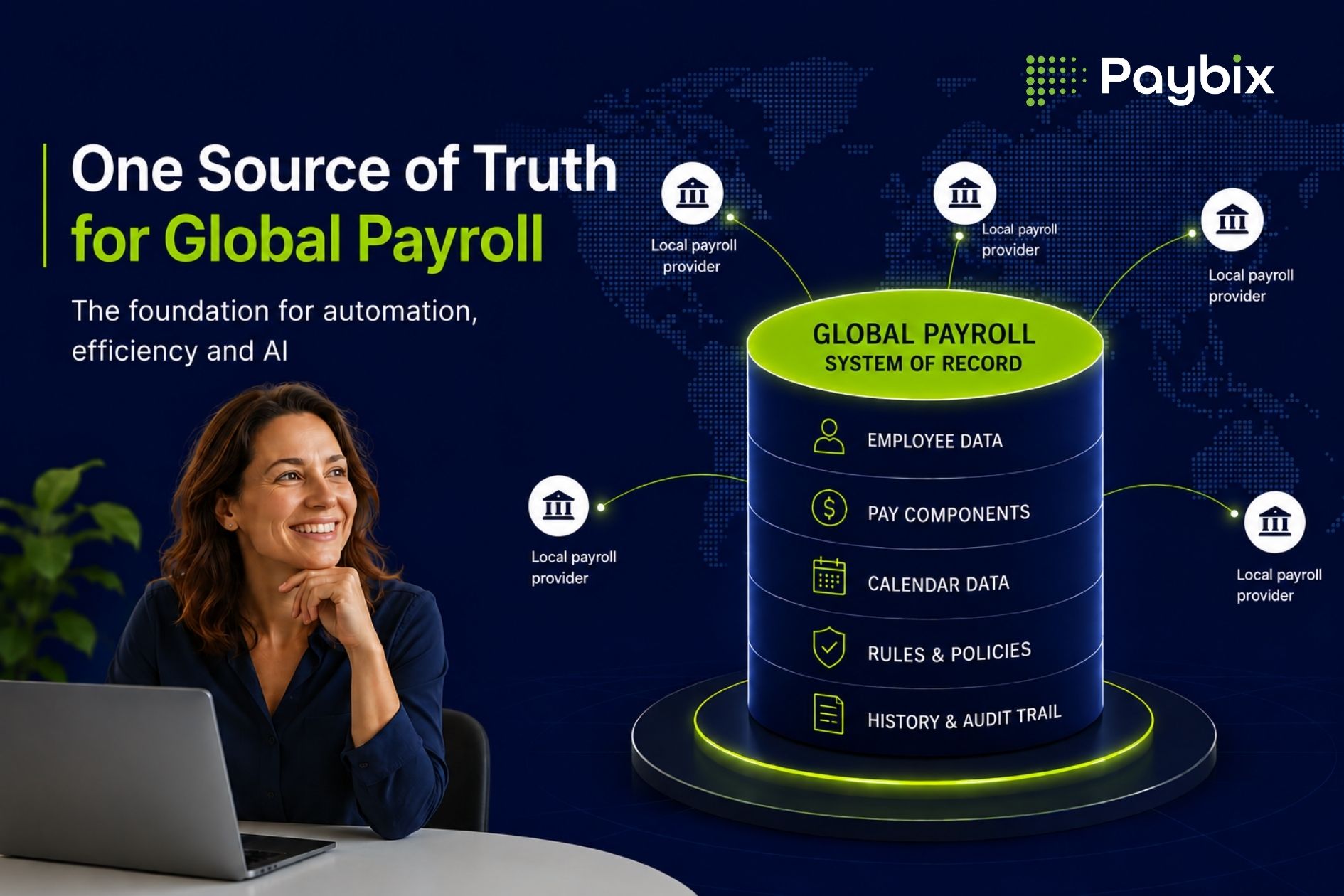
It should contain the payroll-relevant data of employees across the organization, regardless of where they are employed or which local payroll provider processes their salary.
And when we say payroll data, we mean all payroll data.
That includes fixed salary, but also the individual components that make up an employee's total reward package: commissions, insurance, benefits in kind, company cars, meal voucher deductions, allowances, premiums and many others.
It should also include one-off and variable pay components such as overtime, bonuses and other payroll inputs.
The same principle applies to calendar information. Working days, absences, holidays and other payroll-relevant calendar data for employees around the world can be kept in one central location, including information received from time and attendance systems.
The global system of record therefore becomes the central payroll data layer between the organization and its local payroll providers.
Local payroll engines can still do what they do best: calculate payroll according to local legislation and requirements. But the organization itself maintains a global, structured and authoritative view of the data feeding those payrolls.
That distinction is extremely important.
Without a system of record, which data is actually correct?
Consider a relatively simple example.
Your payroll team keeps the value of an employee's allowance in an Excel spreadsheet. The local payroll provider also stores that allowance in its payroll system.
Are the two values identical?
Probably. But probably is not good enough for payroll.
To know for certain, someone needs to compare them.
If your team has access to the provider's local payroll application, an employee can log in and check. If it does not, somebody has to contact the provider and ask.
Now multiply that problem by hundreds or thousands of employees, dozens of pay components, multiple legal entities and perhaps 20, 30 or 40 countries.
What initially looked like a minor inconvenience becomes a structural problem.
With a global system of record, the model changes. There is one authoritative value for that pay component. That value can be transmitted to the local payroll provider, and changes can be tracked centrally.
Instead of asking, "Which system has the correct value?", you know where the correct value originates.
Variable pay should not mean manual work
The problem becomes even clearer when pay components are variable.
Imagine an employee receives an allowance for every day they work from home. Another employee receives an allowance based on the number of days worked. Others receive commissions, shift premiums or other variable compensation.
Someone has to calculate those amounts before they reach payroll.
Without a structured system of record, that calculation often happens in Excel. Payroll teams collect information from different sources, apply formulas, check the results and send the final values to the payroll provider.
And they repeat the exercise during the next payroll cycle.
There is nothing inherently complex about many of these calculations. The problem is that the underlying data and rules are not available in a sufficiently structured environment to automate them.
A global payroll system of record changes that.
If the system knows that an employee receives a certain amount for every eligible work-from-home day, and it receives the employee's calendar or time and attendance data, the variable amount can be calculated automatically.
Once the data and the rules are available in one structured environment, calculations that previously required spreadsheets and manual intervention can simply be automated.
That is where a system of record starts producing much more than better data management. It becomes the foundation for continuous efficiency gains.
A system of record also enables workflow automation
Payroll does not operate in isolation. Many events during an employee's lifecycle trigger activities across several departments and external partners.
Take a new hire.
Personal and employment data needs to be registered. A laptop may have to be ordered. The employee may need a badge and a company car. An account needs to be created in the company's IT environment.
At the same time, information may need to be sent to external parties: an insurance company, a leasing provider, the local payroll provider or government authorities.
In many organizations, these activities are still coordinated through emails, spreadsheets, tickets and manual follow-ups.
But the underlying event is very simple:
A new employee has been created.
If there is a central system that knows this has happened and contains the necessary structured data, that event can trigger a workflow. Information can be sent to the appropriate systems and providers, tasks can be created automatically, and exceptions can be routed to the people who actually need to intervene.
The same principle applies to salary changes, promotions, bonuses, changes in working schedules, long-term absences and employees leaving the company.
Automation becomes possible because there is a reliable event and a reliable set of data to automate from.
Without that foundation, you are effectively trying to automate a process while still asking humans to determine what happened and which information is correct.
And then there is AI
This is where the discussion becomes particularly important.
Global payroll teams have struggled with large volumes of manual work for decades. Today, many organizations understandably look at AI and see an opportunity to finally change that.
And AI can absolutely transform payroll operations.
But AI does not magically solve fragmented data.
An AI agent can analyze data, identify anomalies, answer questions, initiate workflows, suggest corrections and potentially execute an increasing number of payroll-related tasks. But to do any of this reliably, it needs access to structured, trustworthy and sufficiently complete data.
Imagine asking an AI agent:
"Which employees received a different car allowance this month compared with last month, and which changes were not caused by a contractual update?"
If the relevant information is spread across spreadsheets, emails and different local payroll systems, answering that question reliably is extremely difficult.
If the organization has a global system of record containing historical pay components, employment data and payroll inputs, it becomes a fundamentally different problem. The AI has structured information it can analyze.
Or imagine asking:
"Calculate the work-from-home allowance for every eligible employee this month."
For AI to execute that task reliably, it needs to know who is eligible, what rule applies to each employee, how many eligible days they worked and which exceptions need to be considered.
Again, the intelligence is only useful if the underlying data exists in a structured and reliable form.
This leads to an important conclusion:
AI is not a substitute for a global payroll system of record. A global payroll system of record is what makes meaningful AI-powered payroll automation possible.
Building the data foundation for global payroll
This is the principle Paybix brings to global payroll: creating a standardized global system of record for payroll data across countries, employees and payroll providers.
That distinction matters.
Many global payroll solutions can aggregate payroll outputs from multiple local providers and present them in a consolidated global view. But aggregating payroll outputs is not the same as creating a global system of record for the data that drives payroll in the first place.
Paybix takes a different approach. It creates a standardized global data layer in which payroll-relevant employee data can be maintained centrally, regardless of the country in which the employee works or the local payroll engine that ultimately calculates the payroll.
Employee data, recurring and variable pay components, calendar information and payroll inputs can therefore be maintained in one consistent structure and exchanged with the appropriate local payroll providers.
And importantly, this does not require companies to replace every local payroll engine with one enormous global calculation engine.
Local payroll providers can continue to handle the local complexity they know best, while the organization gains control over the global data layer above them.
The result is something global payroll teams have historically struggled to achieve: one structured, standardized and accessible source of truth across the entire payroll landscape.
Once that foundation exists, the possibilities expand significantly.
Data can be validated automatically. Variable pay components can be calculated automatically. Workflows can be triggered by events rather than emails. Payroll teams can focus on exceptions rather than repetitive processing. Management can obtain a global view without consolidating dozens of spreadsheets.
And, increasingly, AI agents can work with payroll data because that data is structured, accessible and trustworthy.
You cannot automate what you have not structured
For years, the payroll industry has tried to improve efficiency primarily by making individual steps in the payroll process faster.
AI creates the opportunity to think much bigger.
But there is no shortcut around the data foundation.
If your global payroll data remains fragmented across spreadsheets, emails, local systems and providers, every new layer of automation eventually runs into the same obstacle: it does not have one reliable version of the truth.
A global system of record changes that.
It gives payroll teams control over their data. It gives automation a reliable foundation. And it gives AI the structured context it needs to become genuinely useful.
The future of global payroll may be increasingly automated and AI-driven. But before companies can build that future, they first need to build the global system of record it can run on.
Author: Hans Joris - hans.joris@paybix.eu
Discover our latest updates.


.png)