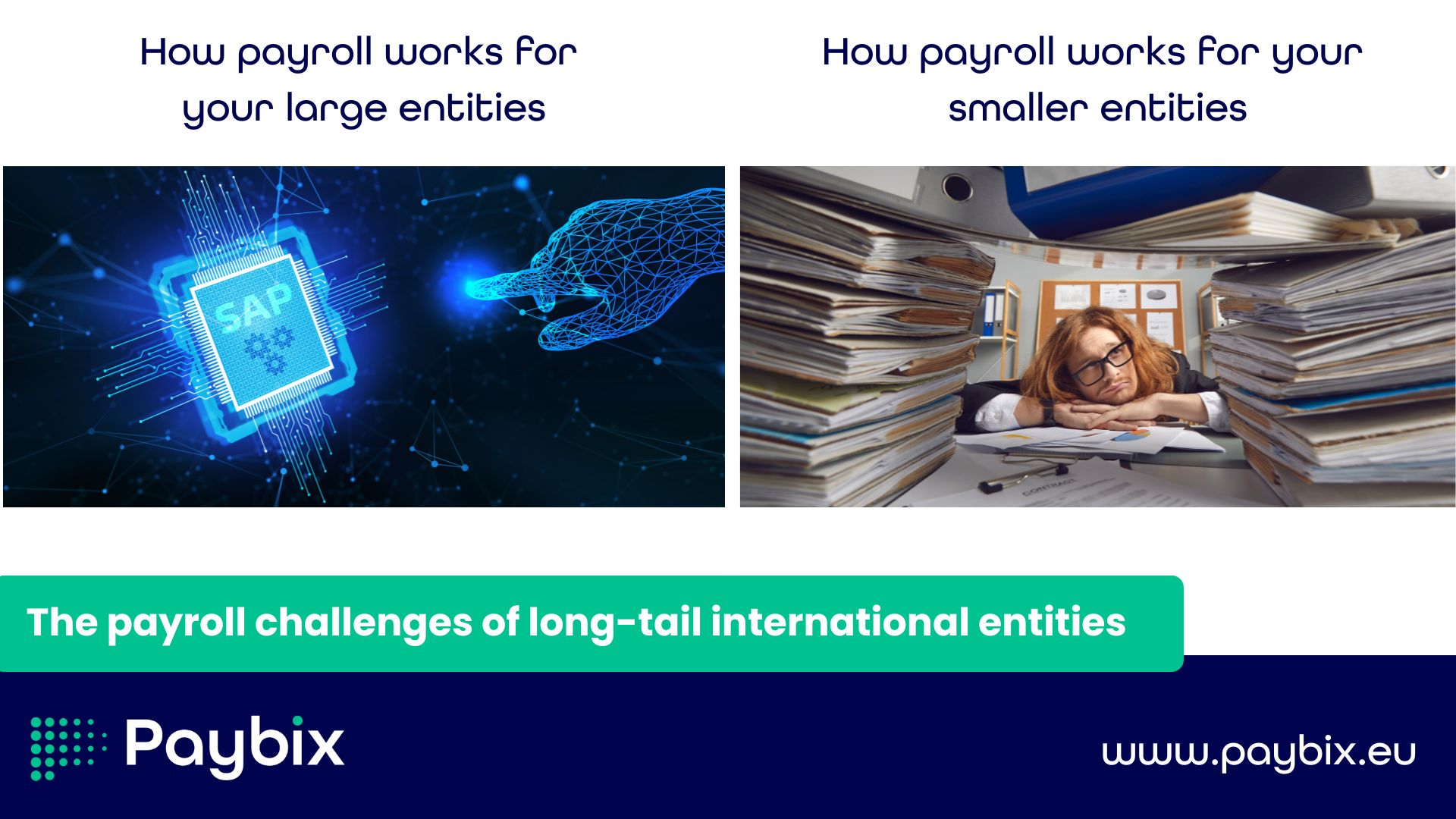
The global payroll challenges of long-tail entities
For large multinational organizations, managing payroll is a complex operation. While payroll for major subsidiaries is often well-structured and standardized, the real challenge lies in managing the so-called ‘long-tail entities’ — the smaller subsidiaries and affiliates scattered across many countries, often with just a handful of employees each.
The Long-Tail Challenge in Global Payroll
Long-tail entities are notoriously difficult to manage at scale. Each one may have its own local payroll provider, its own data formats, its own compliance requirements, and its own way of communicating with the central HR or payroll team.
Common pain points include:
- Lack of visibility into payroll data across all entities
- Inconsistent processes and reporting formats
- High manual effort to consolidate data and ensure compliance
- Difficulty onboarding new entities quickly
- Limited leverage with local payroll providers due to small employee volumes
Why Standard Solutions Fall Short
Most global payroll platforms are designed for large, high-volume operations. They work well for the top-tier subsidiaries but tend to be over-engineered, expensive, or simply impractical for long-tail entities.
A Smarter Approach: Unified Platform with Local Flexibility
The key to solving the long-tail challenge is a payroll platform that combines centralized oversight with local flexibility. Rather than forcing every entity into a one-size-fits-all solution, a smart global payroll platform should connect seamlessly with existing local payroll providers, standardize data collection and reporting, and provide real-time consolidated insights.
The Paybix Approach
At Paybix, we built our platform specifically to address these challenges. Our plug-and-play integration model means that connecting a long-tail entity to the platform is fast and straightforward.
Conclusion
Long-tail entities are often the hidden complexity in global payroll. But with the right platform, they don’t have to be a source of inefficiency or risk. If you’d like to learn more, contact us.
Discover our latest updates.
.png)