From Flexiform Frustration to Payroll Control and Automation
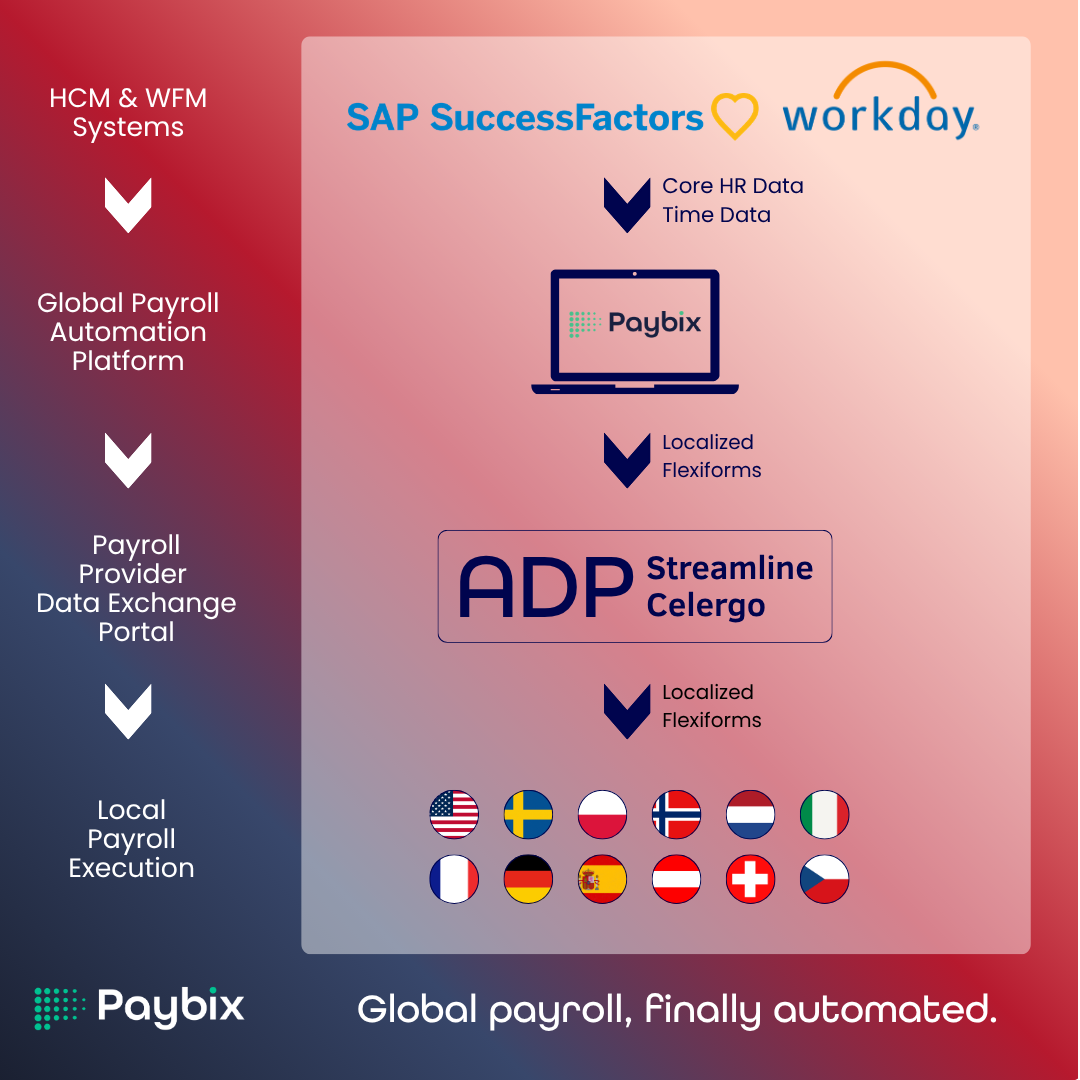
Automating Flexiform Input for ADP* Streamline & Celergo Inputs Without Changing Your Core Systems
Global payroll rarely breaks down at the calculation stage. More often, the real complexity sits much earlier — in the way payroll input is gathered, prepared, and handed over.
Global payroll teams receive data from many different sources. HCM systems provide employee data. Time & Attendance or WFM systems deliver working hours and absences. Finance teams submit one-off payments, corrections, and bonuses. Local teams contribute country-specific adjustments.
Frequently, this information arrives combined in a single file, covering multiple countries and pay elements. Before payroll can even begin, that file must be manually split, restructured, validated, and mapped per country.
Each manual step increases the risk of errors and consumes valuable time — especially when this work remains unautomated.
Where manual effort accumulates
Before data reaches ADP Streamline or Celergo, payroll teams spend a significant amount of time preparing it.
Combined input files are divided per country. Columns are reshaped to match local Flexiform requirements. Pay elements are mapped to country-specific pay codes. Exceptions are handled outside the system. Changes are tracked across emails and spreadsheets.
As the number of countries grows, this effort increases disproportionately. What should be a predictable payroll cycle becomes difficult to oversee and hard to control.
ADP as part of the payroll landscape
ADP Streamline and Celergo are commonly used as standardized interfaces to local payroll providers. They play an important role in payroll execution and data exchange.
However, they are not designed to manage or automate payroll input across multiple upstream systems, nor to orchestrate the full payroll cycle. As a result, much of the coordination and preparation work happens outside the platform — particularly around Flexiforms.
The challenge is not the payroll engine itself, but the absence of a single place where payroll input is structured, validated, and governed end-to-end.
One platform for managing the entire payroll cycle
In this context, our platform becomes the new central point of control.
It is where payroll input from all sources is gathered and consolidated. It is where payroll cycles are initiated and monitored. And it is where payroll data is validated, structured, and prepared for delivery.
Flexiforms are no longer manually created. They are automatically generated per country, in the required structure, format, and pay codes expected by ADP Streamline or Celergo.
Instead of managing files, payroll teams manage payroll cycles.
Operational impact for payroll teams
The shift is both practical and measurable.
Manual file handling is reduced. Errors caused by splitting, mapping, and reformatting input data are significantly lowered. Country onboarding becomes structured rather than complex. Knowledge is embedded in the process instead of residing in spreadsheets or individual inboxes.
ADP continues to act as the execution layer and gateway to local payroll providers, while the complexity of preparation and coordination is handled upstream in a controlled and automated way.
Amplifying what already exists
This is not about replacing payroll systems or disrupting established processes.
It is about amplifying the existing payroll landscape with an orchestration layer that brings automation, structure, and transparency to the most demanding part of global payroll: the input phase.
Flexiforms remain part of the process — but no longer the source of frustration.
Explore further
If your team is still preparing Flexiforms manually every month, it may be time to introduce an orchestration layer above your payroll systems.
If you would like to explore how this approach could simplify your payroll processes, reach out to me on hans.joris@paybix.eu.
I’d be happy to discuss how this could work in your specific payroll landscape.
* ADP, Celergo & ADP Streamline are registered trade marks of ADP, Inc. and its related companies ("ADP"). Paybix is not affiliated with, endorsed by, or in partnership with ADP. References to the trade marks of ADP are made solely for the purpose of describing technical compatibility.
Discover our latest updates.



.png)